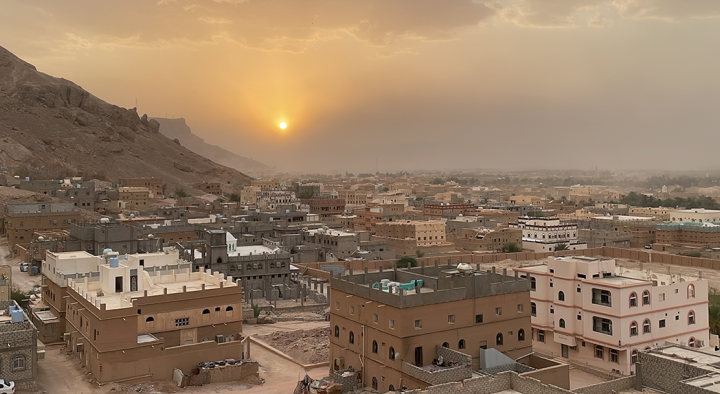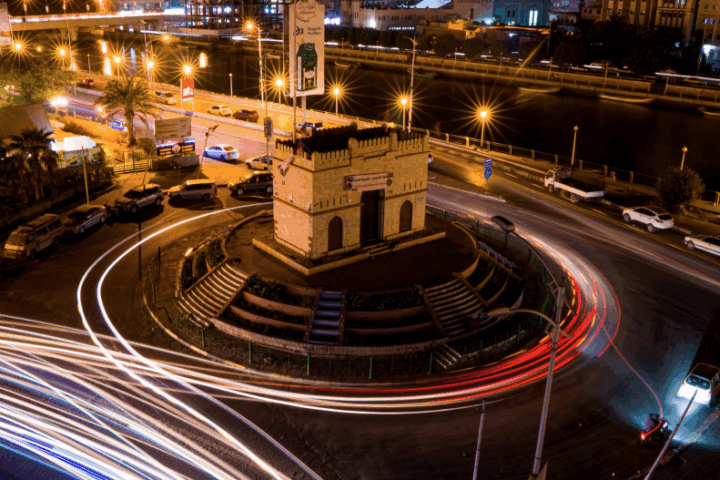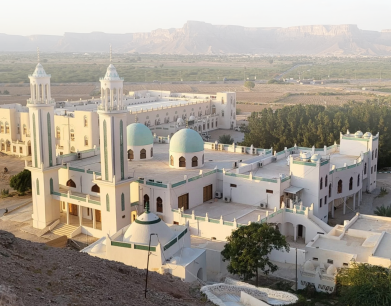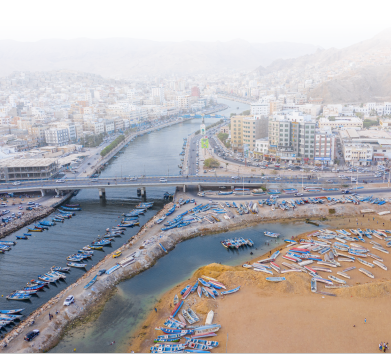

The Governorate of Hadhramout is located in the southeastern part of the Republic of Yemen, 794 kilometers east of the capital of Sana’a, between Al-Mahra to the east and Al-Jawf, Marib, and Shabwah to the west. The governorate is divided administratively into 28 districts, with the city of Mukalla as its capital. Hadhramout is the largest governorate of Yemen by area. It borders the Kingdom of Saudi Arabia in the north.
Hadhramout governorate information
Map of Hadhramout
Economy
Most of the economically active population in Hadhramout is engaged in agriculture, fishing, or livestock rearing. The governorate produces around 5% of Yemen’s total agricultural production, notably dates, cereals, and cash crops. Hadhramout’s coast includes rich fisheries in the Arabian Sea. Alongside Marib and Shabwah, the governorate is home to the main oil-producing region of Yemen. Other mineral resources, such as gold, are present, but not currently exploited in large quantities. Hadhramout has many cultural landmarks, but tourism is very limited.1https://www.yemenna.com/index.php?go=guide&op=show&link=hadrmout. The Al-Wadiyah border crossing with Saudi Arabia generates significant customs revenue. However, Marib currently controls the border crossing.
According to Hadhramout’s 2014 budget, grants and central subsidies constituted 89% of the total revenue for the governorate, while local revenues accounted for 11%. The most significant sources of local revenue were local shared revenues, taxes, income from the sale of goods and services, and fines and penalties.2Republic of Yemen, Ministry of Finance, Budget Sector: estimated local authority budget for the 2014 fiscal year. Please see the appendix for further information on these different types of revenue.
Despite the disruption of central government subsidies in various governorates, the local authority in Hadhramout has kept its local revenues, being far from military confrontations. This has enabled the government to continue regular payment of salaries and to cover the operational costs of the governorate. In addition, the governorate covers the investment budget for services and infrastructure maintenance from oil income, which the governorate currently receives according to a 20%-80% formula. The residents of Hadhramout had previously called for a share of oil income. The “all-inclusive Hadhramout Conference”, held on 26 April 2017, for example, called for increasing the governorate’s share to 20% for reinvestment in the governorate. Hadhramout has also received support from its large diaspora, which has been instrumental for the governorate to continue service provision.3Wadhah al-Aulaqi, Majed al-Madhji, Local Governance in Yemen Under The Conflict and Instability, Sana’a Center for Strategic Studies, July 2018, p. 23 & 31.
According to the 2014 Household Budget Survey, the poverty rate in Hadhramout was 60% of the total population. This number has likely increased since. Despite the absence of open conflict in the governorate, rapid inflation has eroded purchasing power among the population.
Local governance
The local council of Hadhramout has 28 councilors in addition to the governor.4Website of the Governorate of Hadhramout: http://www.had-local.info/view/4.aspx. Date: 18 March 2019. The local council was disrupted during the period of Al-Qaeda’s rule over Mukalla from April 2015-April 2016. It remains suspended. The council is not operational and has not met in several years. A number of council seats are vacant due to death or absence of councilors, such as the secretary general of the council who has been abroad for the past three years. The executive bureau of the governorate is functioning normally, within the fiscal constraints. The executive offices are supported by the local authority and donor organizations.5Interview with one of the local authority leaders, Hadhramout. March 2019.
Access to basic services
There are approximately 1,000,000 people in need of assistance in Hadhramout (approximately 62% of the population), 56% of whom are in dire need.6https://data.humdata.org/dataset/yemen-humanitarian-needs-overview, 2023 People in Need in Yemen The current IDP population of Hadhramawt is 450,000 (status December 2022).7Ibid.
In the health sector, hospitals and health centers are working regularly to provide services to the population. They are supported by the local authority and by donors. This support has allowed the maintenance of service provision levels as well as expansion and construction of new health facilities and equipment.8Website of the Governorate of Hadhramout: http://www.had-local.info/view/4.aspx. Date: 18 March 2019 Despite functioning health facilities, the services provided are insufficient to meet the demands of the population, especially with the influx of people displaced from Al-Mahra and Shabwah.9Interview with one of the local authority leaders, Hadhramout. March 2019.
Schools in the governorate have not been affected by the conflict. Teachers’ salaries are being paid regularly and education has continued without disruptions.10Economic and Social Development In Yemen Newsletter (Issue No. 30, December 2017), published by the Economic Studies and Forecast Sector in the Ministry of Planning and International Cooperation. As for drinking water, 94% of households in Hadhramout had access to potable water in 2017.11OCHA: An Overview of the Humanitarian Needs in Yemen 2018.
Demographics
| District | Size (km2) | Population (Female) | Population (Male) | Population (Total) |
|---|---|---|---|---|
| Rumah | 26,497 | 5,549 | 5,745 | 11,294 |
| Thamud | 16,242 | 4,030 | 4,169 | 8,199 |
| Al Qaf | 28,741 | 1,868 | 1,927 | 3,795 |
| Zamakh wa Manwakh | 24,205 | 2,425 | 2,512 | 4,937 |
| Hagr As Sai’ar | 2,986 | 2,370 | 2,454 | 4,824 |
| Al Abr | 7,461 | 10,388 | 10,751 | 21,139 |
| Al Qatn | 3,135 | 55,369 | 57,312 | 112,681 |
| Shibam | 118 | 42,144 | 43,624 | 85,768 |
| Sah | 2,541 | 20,067 | 20,775 | 40,842 |
| Seiyun | 804 | 97,372 | 100,789 | 198,161 |
| Tarim | 28,940 | 88,024 | 91,110 | 179,134 |
| As Sawm | 12,341 | 10,645 | 11,019 | 21,664 |
| Ar Raydah Wa Qusayar | 3,534 | 37,878 | 39,206 | 77,084 |
| Ad Dis | 2,400 | 20,053 | 20,759 | 40,812 |
| Ash Shihr | 2,256 | 65,172 | 67,460 | 132,632 |
| Ghayl Bin Yamin | 4,632 | 23,412 | 24,232 | 47,644 |
| Ghayl Ba Wazir | 2,418 | 41,660 | 43,121 | 84,781 |
| Daw’an | 955 | 37,716 | 39,040 | 76,756 |
| AWadi l Ayn | 3,547 | 24,352 | 25,206 | 49,558 |
| Rakhyah | 2,269 | 7,162 | 7,415 | 14,577 |
| Amd | 737 | 16,779 | 17,370 | 34,149 |
| Adh Dhlia’ah | 1,101 | 15,225 | 15,758 | 30,983 |
| Yabuth | 2,499 | 8,227 | 8,518 | 16,745 |
| Hajr | 1,741 | 21,521 | 22,279 | 43,800 |
| Brom Mayfa | 2,256 | 13,361 | 13,828 | 27,189 |
| Al Mukalla | 955 | 14,904 | 15,426 | 30,330 |
| Al Mukalla City | 1,008 | 153,396 | 158,782 | 312,178 |
| Huraidhah | 1,222 | 15,931 | 16,492 | 32,423 |
| TOTAL | 187,542 | 857,000 | 887,079 | 1,744,079 |
Figures are based on the 2025 Humanitarian Needs Overview Yemen, OCHA. Population figures include the number of IDPs and residents.