
This manual was designed for local councilors and civil society organisations in Yemen. It introduces the role of local councils within the local governance set-up of Yemen and introduces tools that councilors and civil society actors can use to monitor expenditure and improve relations with citizens. It introduces a six-step process for assessing public expenditure that culminates in a public meeting.
Other resources you may be interested in:
Accountability mechanisms in Yemen: Insights from Taiz, Aden, Hadhramawt, and Al Mahra
Analysis of the de jure and de facto state of accountability in Yemen, with case studies on accountability mechanisms in the four governorates of Taiz, Aden, Hadhramawt and Al Mahra.
Navigating post-conflict governance in Yemen: Decentralization, federalism, and the path to stability.
This journal article examines enhanced decentralization, federalism, and secession as alternative post-conflict governance models for Yemen and assesses their implications for stability and state-building. The study investigates what governance arrangements best align with Yemen’s political, social, and economic context; how institutional legitimacy and local autonomy can be balanced in a fragile, divided state; and what […]
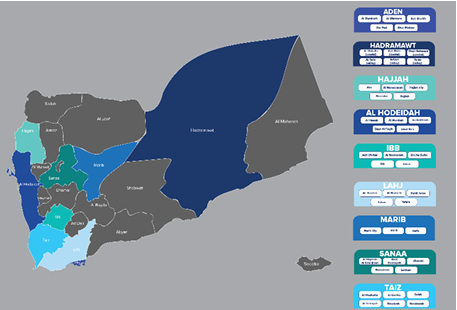
Strengthening Institutional and Economic Resilience in Yemen (SIERY) – Final Evaluation Report.
This final project evaluation assesses the UNDP SIERY project’s performance from 2020–2025 in strengthening local governance, public service delivery, and economic resilience across nine governorates in Yemen. Given this project has been the largest project in terms of funding volume and geographical coverage supporting local governance in Yemen, it offers interesting insights in the opportunities […]